

Project 1:
Phenological mismatches in California vernal pool plant-pollinator communities
California's vernal pools harbor many rare and threatened annual wildflowers that depend on pollinators for seed set, making synchronized flowering and pollinator emergence essential to their persistence. Yet surprisingly little is known about which pollinators actually visit these flowers.
At the Merced Vernal Pools and Grassland Reserve, I conducted the first systematic pollinator survey of this community, alongside continuing a long-term plant phenology monitoring effort. Over the past decade, our lab has documented a notable shift: two focal species, Trifolium variegatum and Limnanthes douglasii ssp. rosea, are now flowering 4–5 days earlier per year since 2016.

Limnanthes douglasii ssp. rosea with an Andrena bee
Research Questions
1. What pollinators are visiting the vernal pool plants at the Merced Vernal Pool and Grassland Reserve?
2. Is the emergence of the pollinators synchronous with the flowering emergence, or is there a phenological mismatch?
3. What environmental cues are the plants and pollinators responding to most strongly for emergence timing?
Methods
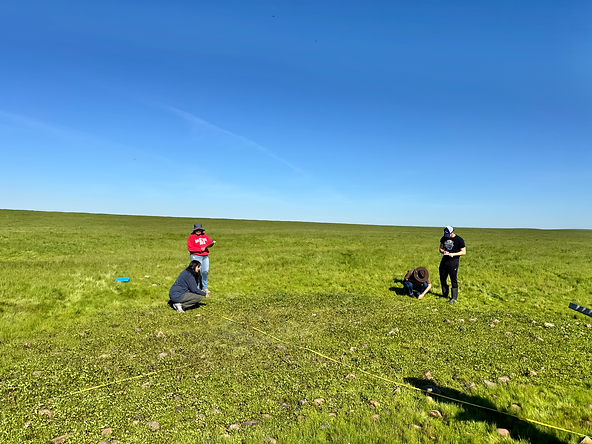
Focal species transects
Transect surveys of T. variegatum and L. douglasii spp. rosea capturing abundance at each life history stage cross the season.

Community phenology survey
Weekly documentation of first flowering dates and bloom duration across the broader vernal pool plant community, tracking how phenology shifts year to year.

Pollinator surveys
Active and passive sampling to identify which pollinators visit vernal pool flowers and when. Included pan traps of three colors (blue, yellow and white) as well as handnetting species when interacting with flowers. Post-survey work includes identifying specimens, and curating them.


This research has been supported by collaborator Dr. Marilia P. Gaiarsa, and my advisor Dr. Jason P. Sexton.
Additional funding comes from Northern California Botanist, California Native Plant Society, and the California Native Grassland Association.
Project 2:
Reproductive consequences of pollinator loss, pollen competition, and phenological mismatch in Limnanthes douglasii ssp. rosea
Limnanthes douglasii ssp. rosea, or rosy Douglas' meadowfoam, is a vernal pool annual found only in California's eastern Central Valley. Despite being self-compatible, it relies on insect pollinators for 80–95% of its reproduction, making it highly sensitive to anything that disrupts the plant-pollinator relationship.

Limnanthes douglasii ssp. rosea
At the Merced Vernal Pools and Grassland Reserve, this species faces a convergence of reproductive pressures: potential phenological mismatch with its pollinators as climate shifts flowering earlier, competition from heterospecific pollen deposited, and the broader threat of pollinator decline. Any one of these stressors can reduce seed set, but how much, and do they interact?
This project uses a manipulative field experiment to find out. By controlling what pollen plants receive, and when, across early, middle, and late flowering periods, we can isolate the fitness consequences of pollinator loss, pollen competition, and phenological mismatch in a single, unified design.
Research Questions:
1. What are the fitness costs of pollinator loss?
Given that L. douglasii ssp. rosea outcrosses 80–95% of the time, does pollinator exclusion force inbreeding, and if so, what are the consequences for seed set and viability?
2. Does heterospecific pollen reduce fitness?
In a floristic biodiversity hotspot where competition for pollination services occurs, does exposure to foreign pollen result in measurable fitness differences compared to conspecific pollination alone?
3. How does phenological mismatch affect seed set?
If plants experience pollen limitation due to pollinator mismatch, do fitness consequences differ when pollen is supplemented at early, middle, or late-season time points?
Pollination Treatments
To isolate the reproductive consequences of pollinator loss, heterospecific pollen, and phenological mismatch, we applied four treatments to Limnanthes douglasii ssp. rosea across early, middle, and late flowering periods: hand-pollination with bagging, hand-pollination left open to natural visitors, full pollinator exclusion, and unmanipulated open pollination as a baseline. Comparing seed set and seed mass, these treatments lets us quantify the fitness costs of each stressor independently and in combination.

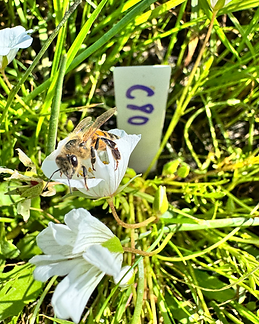

Photo 1 shows meadowfoam being excluded from pollinators. Photos 2 shows a honey bee pollinating a control- wild pollination- meadowfoam flower. Photo 3 shows meadowfoam seeds produced.
This research has been financially supported by Dr. Jason P. Sexton, the Merced Vernal Pools and Grassland Reserve Swarth Fogel Scholarship, Northern California Botanist, and the California Native Plant Society.
